Meta Still Reigns Supreme: How Facebook, Instagram, and WhatsApp Maintain Global Social Media Dominance

TECHVIPUL
0
Meta Platforms social media apps overview
📊 Digital Census 2026

The Anatomy of Meta’s Hegemony

Three Billion-User Titans: Facebook, Instagram, and WhatsApp

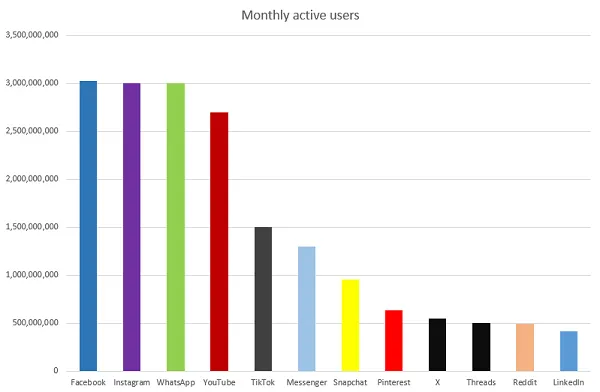
The digital communications landscape continues to evolve under the immense gravitational pull of Meta Platforms, Inc. Despite shifting consumer habits, regulatory pressures, and intense competition from specialized video and text-sharing networks, Meta maintains an unprecedented lead in global social media reach. The foundation of this dominance rests upon an extraordinary milestone: three distinct applications within its ecosystem—Facebook, Instagram, and WhatsApp—each command monthly active user bases exceeding the three billion mark.

This achievement represents a staggering scale, meaning that nearly half of the global human population regularly navigates at least one of these digital environments. Facebook, the foundational network launched in 2004, crossed the three billion monthly active user threshold in 2023. It has persistently defied predictions of saturation by expanding its roots deeply across developing international markets while maintaining strong daily habit loops in mature regions. WhatsApp followed closely as an indispensable global utility, hitting its three billion user milestone during the first quarter of 2025 across more than 180 countries. Most recently, Instagram crossed the same monumental threshold in September 2025, cementing its status as the premier visual culture and creator-driven network.

The simultaneous operation of three multi-billion-user pillars provides Meta with structural resilience that no single-product rival can match. While individual networks experience localized fatigue or shifting generational trends, the cross-pollination of user graphs within the Meta family insulates the parent corporation from systemic collapse. This tripartite architecture ensures that whether a user seeks long-form social networking, private or group messaging, or immersive visual storytelling, they remain comfortably within the Meta enclosure.

Family of Apps Dynamics and the 3.56 Billion Daily Benchmark

To truly understand the operational scale of Meta, one must examine its consolidated metrics rather than viewing its applications in isolation. Meta formally transitioned its primary public reporting framework toward total Family metrics, tracking the collective engagement across Facebook, Instagram, Messenger, and WhatsApp. In the first quarter of 2026, Meta reported a Family Daily Active People (DAP) metric of 3.56 billion.

Meta Family daily active people and global reach
📱 Meta’s Family of Apps — Facebook, Instagram, Messenger, and WhatsApp — collectively serve 3.56 billion daily active people.

While this represented a minor contraction compared to previous quarters—marking the company's first quarterly dip in its overall reported user count—the absolute volume of human activity captured daily remains staggering. More than 3.5 billion people open a Meta application every single day. This frequency transforms these platforms from mere entertainment options into critical infrastructure for modern human communication, commerce, and civic interaction.

3.56B
Daily Active People (Q1 2026)
3.0B+
Facebook MAU (2023)
3.0B+
WhatsApp MAU (Q1 2025)
3.0B+
Instagram MAU (Sep 2025)

The slight dip in early 2026 reporting points to an increasingly mature digital market where user acquisition has reached its natural geographical boundaries, forcing companies to fight for retention and time-spent metrics rather than raw expansion. Nevertheless, the sheer magnitude of 3.56 billion daily interactions gives Meta unmatched leverage in pricing digital advertising inventory, predicting macro-economic consumer trends, and shaping the flow of global information.

Competitive Landscape and Challengers

YouTube, TikTok, and the Battle for Attention

While Meta retains the crown for aggregate reach, the broader ecosystem features formidable adversaries vying for the world's limited attention span. Chief among them is Google’s YouTube, which stands as the closest standalone challenger to Meta’s multi-app empire. Business of Apps tracking places YouTube’s monthly active user base at approximately 2.7 billion. While YouTube guards its exact monthly active user figures closely, its dominance in video consumption is undeniable, underscored by explosive growth in its Shorts feature—surging from roughly 30 billion daily views in 2022 to an astonishing 200 billion daily views by 2026.

Meanwhile, TikTok continues to represent a powerful cultural centrifuge, though tracking its precise trajectory has grown more complex. TikTok reported one billion monthly actives back in 2021, with subsequent estimates from market researchers placing its reach around 1.6 billion, though official confirmations from the platform have been sparse. Furthermore, regulatory headwinds, geopolitical restrictions, and legislative battles in key regions have introduced friction into TikTok's expansion path. These hurdles have occasionally prevented it from matching the frictionless, ubiquitous utility that WhatsApp or Facebook enjoys across diverse international jurisdictions.

“While rivals can capture intense bursts of cultural relevance—particularly among younger demographics through short-form video—translating that engagement into the foundational, multi-generational utility achieved by Meta remains an exceptionally difficult feat.”

Emerging Competitors: Threads, Snapchat, and the Niche Players

Beneath the tier of multi-billion-user giants, a fierce secondary contest is unfolding among platforms carving out specialized domains. Meta’s own text-based conversational app, Threads, has mounted a persistent challenge against X (formerly Twitter). Having launched during a period of industry turbulence, Threads climbed to 500 million monthly active users, running neck-and-neck with X, which maintains approximately 550 million monthly actives. This rivalry highlights how Meta can successfully incubate internal challengers to disrupt alternative public discourse spaces.

Elsewhere, Snapchat is steadily approaching the one-billion-user milestone, reporting 956 million monthly active users in the first quarter of 2026. Snapchat’s growth has been significantly propelled by robust adoption in regions like India, where it functions as a vital communication bridge for younger demographics. Similarly, Pinterest has surprised market analysts by expanding its monthly active user count to 631 million, proving that intent-driven visual discovery platforms retain high utility for commercial planners and shoppers.

Text- and professional-centric networks occupy yet another distinct tier. Reddit reported 126.8 million daily active users in early 2026, anchoring deep community-led discussions that traditional social feeds often fail to replicate. LinkedIn, while reporting a total registered member count of 1.3 billion, operates on a different engagement metric entirely; European Union transparency data indicates that roughly 32 percent of its EU members use the platform monthly, translating to an estimated 416 million monthly active users globally. Each of these platforms proves that digital reach is no longer a monolith, but a fractured ecosystem where distinct user intents dictate success.

Strategic Shifts in Global Digital Attention

Moving Beyond Platform-Specific Reporting

A critical development in corporate transparency is Meta’s strategic decision to phase out granular, platform-specific monthly active user disclosures in its regular quarterly performance updates. By pivoting exclusively to its combined Family metrics, Meta has fundamentally shifted how financial analysts, digital marketers, and tech journalists evaluate its footprint. This change reflects a mature corporate philosophy: the individual boundaries between Facebook, Instagram, Messenger, and WhatsApp are intentionally blurring into an integrated utility suite.

For digital marketers and brand strategists, this lack of hyper-granular, real-time platform breakdowns forces a reliance on milestone achievements and aggregate behavioral trends rather than localized headcounts. When Meta announces that Instagram hit 3 billion users in late 2025 or that WhatsApp achieved the same milestone earlier that year, it serves as a macroeconomic indicator of where global screen time is locked. Consequently, advertising budgets are increasingly allocated based on overarching audience overlap rather than isolated platform metrics. Brands must recognize that a consumer targeted on Instagram is frequently part of the same unified graph interacting on WhatsApp or viewing content on Facebook.

The Rise of AI Integration and Advertising Utility

As raw user growth decelerates into a plateau dictated by global demographics, Meta’s strategic pivot has centered squarely on artificial intelligence integration and advanced monetization models. The company’s investments in generative AI have manifested rapidly across its application stack. Meta AI evolved into a major consumer touchpoint, crossing the threshold of one billion monthly active users. Concurrently, open-source initiatives like the Llama model series have surpassed hundreds of millions of downloads, establishing Meta as a heavy infrastructure player in the broader machine learning economy.

This aggressive AI push serves a dual purpose. First, it redefines the in-app experience by embedding conversational search, automated content creation, and multimodal reasoning directly into messaging and social feeds. Second, it supercharges Meta's core advertising engine. By leveraging deep machine learning models to optimize ad placement, predict consumer intent, and streamline conversion paths, Meta maximizes the value of its 3.56 billion daily active users. Even as privacy regulations tighten and user fatigue causes periodic dips in raw activity, the sophistication of Meta's targeted ad ecosystem ensures that its economic gravity remains largely unrivaled.

Conclusion

The latest digital census confirms an enduring reality of the modern internet: Meta continues to command the widest social media reach on Earth. With Facebook, Instagram, and WhatsApp each standing independently atop the three-billion-user mountain, and a combined daily active user base of 3.56 billion, the corporation has woven itself directly into the fabric of global society.

While nimble competitors like TikTok, YouTube, Snapchat, and specialized networks capture vital segments of cultural attention and creative expression, none have replicated the sheer structural breadth of Meta's ecosystem. As the industry pivots toward artificial intelligence integration, automated advertising, and immersive computing, Meta's unrivaled access to human connection ensures it will dictate the terms of digital engagement for the foreseeable future.

Frequently Asked Questions

Which Meta apps have surpassed 3 billion monthly active users?
Facebook, Instagram, and WhatsApp have all officially surpassed 3 billion monthly active users. Facebook reached this milestone in 2023, WhatsApp hit it in early 2025, and Instagram crossed the threshold in September 2025.
What is Meta's total daily active user count across its applications?
In its Q1 2026 financial reporting, Meta recorded 3.56 billion Family Daily Active People (DAP), representing the combined unique users engaging with Facebook, Instagram, Messenger, or WhatsApp on a daily basis.
How does YouTube compare to Meta in terms of active user reach?
YouTube stands as Meta's closest standalone competitor, with an estimated 2.7 billion monthly active users. YouTube has also experienced massive growth in its Shorts feature, scaling from 30 billion daily views in 2022 to 200 billion daily views by 2026.
What is the current user status of emerging platforms like Threads and Snapchat?
As of 2026, Meta's text-based app Threads has reached 500 million monthly active users, putting it roughly neck-and-neck with X, which reports 550 million. Meanwhile, Snapchat has grown to 956 million monthly active users, driven largely by adoption among young demographics in regions like India.
How large is Meta AI's user base following its integration?
Meta AI has scaled rapidly across the company's application family, officially surpassing 1 billion monthly active users as the technology became deeply embedded within Facebook, Instagram, WhatsApp, and Messenger.

Post a Comment

0 Comments

If you have any doubts, Please let me know

Post a Comment (0)

#buttons=(Ok, Go it!) #days=(20)

Our website uses cookies to enhance your experience. Check Now
Ok, Go it!